
Non-verbal activities can help educators create more inclusive and participatory learning environments. Through movement, rhythm, visual expression, imitation and group interaction, learners can communicate and connect in ways that do not depend only on spoken language.
These methods can be useful in classrooms, adult education sessions, language courses, workshops, youth work and community projects. They are especially relevant when participants have different languages, cultural backgrounds, confidence levels or learning needs.
The aim is not to replace verbal communication. It is to give learners more ways to participate.
Why non-verbal activities support inclusion
Traditional learning often gives the most space to people who are confident speakers. Other learners may need more time to formulate an answer, may not feel comfortable speaking in front of a group or may communicate more naturally through movement, images and observation.
Non-verbal activities can help to:
-
Reduce pressure related to speaking
-
Encourage participation from quieter learners
-
Support communication in multilingual groups
-
Build trust between participants
-
Create a stronger sense of belonging
-
Develop cooperation and empathy
-
Make learning more active and memorable
The Erasmus+ project “Promoting creative non-verbal techniques to foster social inclusion and group cohesion” explored these methods with a particular focus on trainers working with migrants and adults with fewer opportunities.nonverbalmethods
Start with the needs of the group
The same activity will not work in exactly the same way with every group. Before choosing an exercise, the facilitator should consider the participants and the learning context.
Ask yourself:
-
How well do the participants know each other?
-
Are they comfortable with movement?
-
Are there language barriers?
-
Does the activity require eye contact or physical contact?
-
Can the activity be adapted for people with reduced mobility?
-
Are there cultural expectations that may affect participation?
-
Does the group need energy, calmness, cooperation or reflection?
Knowing the group helps the facilitator select an activity that is suitable and respectful.
An exercise designed to build energy may not be appropriate at the beginning of a session with participants who feel anxious. In that situation, a calm visual or creative activity may be a better starting point.
Begin with simple activities
The training plan recommends introducing non-verbal methods progressively. Short ice-breakers and warm-ups can help participants become familiar with the approach before they try more personal or physically demanding exercises.
Useful starting activities include:
-
Simple stretching with imitation
-
Passing a gesture around a circle
-
Expressing a name and emotion with a gesture
-
Creating a collective drawing
-
Using rhythm and clapping
-
Walking around the room and responding to simple instructions
These activities are easy to explain and can help the facilitator understand the group’s energy, confidence and willingness to participate.
As trust develops, the facilitator can introduce activities that involve more creativity, cooperation or emotional expression.
Four types of non-verbal activities
The training plan groups the methods into four main areas.
Visual learning
Visual learning activities use drawing, collage, images and other forms of visual expression.
For example, participants can begin a drawing and pass it to another person. Each participant adds something before passing it on again. At the end, the group can observe the final drawings and reflect on the experience.
This kind of activity can support creativity, calmness, cooperation and acceptance of other people’s ideas. It is also suitable for participants who prefer less physical activity.
Embodied learning
Embodied learning connects movement, emotions and thinking.
Participants may use gestures, facial expressions, posture or simple movements to explore a topic. They can express an emotion, mirror a partner’s movement or create a group sculpture.
The focus is not on performance. The aim is to help participants notice how the body can support communication and learning.
Rhythm and sound
Rhythm and sound activities can help groups develop attention, coordination and a shared sense of timing.
A group may pass a sound and gesture around a circle or create a simple rhythm together. These activities can be adapted for seated participation and often require only a small amount of language.
They can be useful with multilingual groups because participants can understand the activity through demonstration and repetition.
Outdoor and environmental learning
Outdoor activities use movement, space and the natural environment as part of the learning process.
A group may follow a route, complete a cooperative task or observe the surroundings before discussing the experience. Outdoor learning can create opportunities for reflection and interaction that are different from those available in a classroom.
The activity should always be connected to a clear learning purpose. Going outside is not enough by itself. The facilitator should explain what participants are expected to notice, explore or reflect on.
Examples of activities
The imaginary ball
Participants stand in a circle and pass an imaginary ball to one another. The ball can change size, weight, shape or speed.
The activity encourages eye contact, creativity and non-verbal communication. It also helps participants practise responding to other people’s gestures and adapting their own actions.
The imaginary ball can be used with children, adults and multilingual groups. It can also be done while seated.
The mirror
Participants work in pairs. One person moves slowly while the other person mirrors the movement. After a few minutes, they change roles.
The facilitator should encourage small and comfortable movements. Participants should not feel pressure to perform or make dramatic gestures.
The activity can support observation, empathy, emotional awareness and connection. It should always be optional and adapted to the comfort level of the group.
Collective drawing
Each participant starts a drawing and then passes it to another person. The group gradually develops each drawing together.
This activity can help participants explore cooperation and accepting ideas that they did not create themselves. A discussion can follow about how it felt to give up control or contribute to someone else’s work.
Name, feeling and mime
Each participant says their name, chooses an emotion and expresses it through a gesture. The group repeats the name, emotion and gesture.
This is a simple way to learn names and create a relaxed atmosphere. The gesture can be adapted for seated participation and the activity can also support language learning.
Safety and comfort are essential
Non-verbal activities can be inclusive, but they are not automatically suitable for everyone. Some exercises involve eye contact, touch, movement or emotional expression and may feel uncomfortable for certain participants.
Facilitators should:
-
Explain that participation is voluntary
-
Offer alternatives whenever possible
-
Avoid forcing eye contact or physical contact
-
Demonstrate the activity before starting
-
Use short and clear instructions
-
Introduce more personal activities gradually
-
Observe body language and changes in energy
-
Allow participants to stop or take a break
-
Adapt movements for different physical abilities
-
Respect cultural differences and personal boundaries
The training plan highlights that activities should be selected with care when working with people who have experienced trauma, stress or exclusion. The facilitator should know the group and avoid assuming that a playful activity will feel comfortable for everyone.KA2_Training-Plan-using-the-template-1.docx
Adapt activities for different participants
A non-verbal activity can often be adapted without losing its purpose.
For example:
-
Replace jumping with arm movements or foot tapping
-
Allow participants to remain seated
-
Replace touch with gestures made at a distance
-
Let participants observe before joining
-
Use visual demonstrations instead of long explanations
-
Allow people to work alone before moving into pairs
-
Replace prolonged eye contact with looking at the person’s face
-
Use drawing or sound when movement is not appropriate
Adaptation is not a weakness. It is part of inclusive facilitation.
The goal is not for everyone to perform the activity in exactly the same way. The goal is for everyone to have a meaningful way to participate.
Reflect after the activity
Reflection helps transform an enjoyable activity into a learning experience.
After an exercise, ask simple questions such as:
-
How did you feel during the activity?
-
What was easy or difficult?
-
How did you communicate without using many words?
-
What helped you feel comfortable?
-
What could be changed for another group?
-
How could you use this activity in your own work?
Evaluation should focus on the activity and the facilitation rather than judging individual participants. The facilitator can reflect on whether the exercise supported meaningful interaction, whether people appeared comfortable and whether it achieved its intended purpose.KA2_Training-Plan-using-the-template-1.docx
Access the project resources
The Erasmus+ KA2 project created a training plan and a free online course for educators who want to explore creative non-verbal methods.
The resources include practical exercises related to:
-
Ice-breakers and warm-ups
-
Focus, rhythm and coordination
-
Group cohesion and cooperation
-
Creativity and improvisation
-
Trust and emotional expression
The free online course includes practical materials and video demonstrations that educators can explore and adapt to their own context.epale.europa+1
Access the free online course on non-verbal methods
Continue learning in Tenerife
If you would like to practise these methods with educators from different countries, you can join the Tenerife Courses training course Non-verbal methods to promote inclusion and diversity.
The face-to-face course is based on active learning, non-formal education, group dynamics and creative methods. Participants experience the activities themselves and reflect on how to adapt them for their learners and professional context.tenerifecourses
You can also explore the Erasmus+ course catalogue or check the upcoming course dates in Tenerife.
About the KA2 project
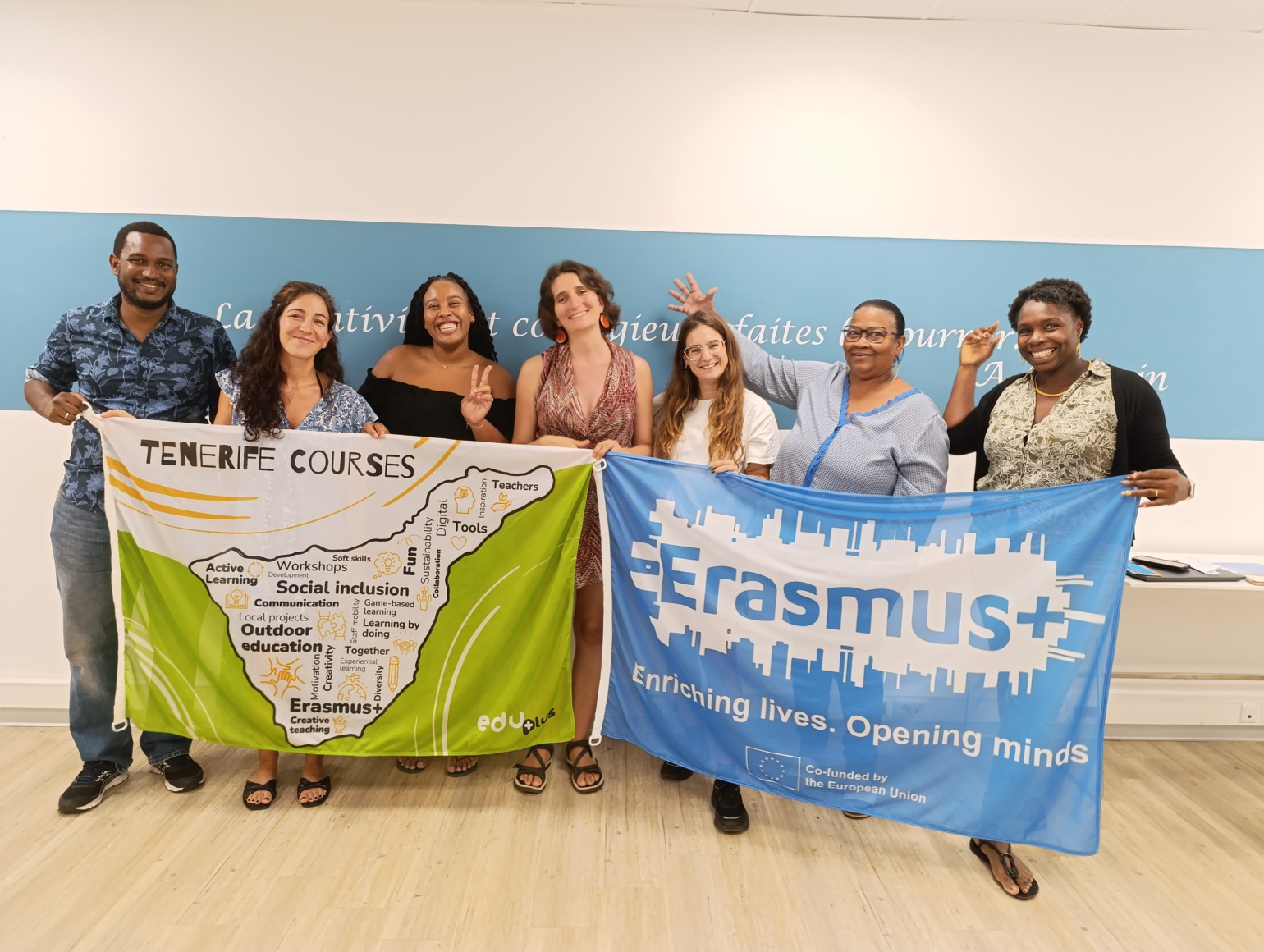
The project “Promoting creative non-verbal techniques to foster social inclusion and group cohesion” was developed by Eduplus Association in Tenerife and On Continue Association in Martinique.
The project explored methods that can help trainers support migrants, adults with fewer opportunities and other people at risk of social exclusion. Its results include the training plan, workshops, video materials, a free online course and the integration of non-verbal methods into Tenerife Courses’ training offer.nonverbalmethodsKA2_Training-Plan-using-the-template-1.docx
Project number: KA210-ADU-C2EAAB9A
Pre-register to our course!