
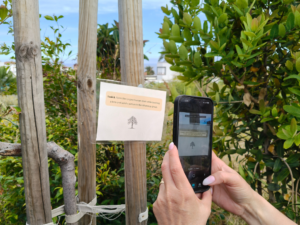
Many educators today feel both excited and unsure about how to use AI in teaching. ChatGPT and similar tools appear everywhere, but it is not always clear how they can support real, meaningful learning — especially outside the classroom. A different way to think about this is to place AI and gamification inside outdoor learning, where the focus stays on people, place, and experience.
In a Tenerife‑based Erasmus+ training course, teachers and trainers explore how to use ChatGPT, AI tools, and gamification as part of outdoor learning, rather than as separate “digital” activities. The idea is not to replace nature or real‑life experience, but to enrich it with simple, playful support.
AI as a creative partner, not a replacement
In this context, AI is treated as a creative partner. Educators learn how to use ChatGPT, Gemini or Claude to generate discussion questions, short scenarios or simple stories that can be used during walks, field visits, or group activities. They also experiment with visual‑AI tools to prepare images or materials that help participants connect with the environment more deeply.
What matters most is intentionality: the educator decides when and how to use the tool and always keeps the learners’ needs, privacy, and critical thinking in focus. AI supports preparation and reflection, but the real learning still happens through observation, conversation and movement in the outdoor space.
Gamification that deepens engagement
Gamification is another layer that can give outdoor learning more structure and energy. Instead of adding meaningless “points” or prizes, participants in the training think about meaningful play:
- simple quests that invite observation and teamwork,
- short challenges that connect to environmental themes,
- collaborative tasks that require listening and problem‑solving.
In this Erasmus+ KA1 training course in Tenerife, the focus is on how game elements can increase motivation without turning learning into a competition. The outdoor setting helps to keep the atmosphere light but reflective, so participants remember both the activity and the ideas behind it.
Competences to be acquired:
- understand the basics of artificial intelligence and its application in education
- develop critical thinking skills to reflect on ethical implications of AI use in education such as data privacy, bias and the social impact of AI
- gain hands-on experience with educational AI tools such as ChatGPT, Gemini, Canva AI, image and video generation and LLM (large language models) for digital content creation and lesson planning.
- learn how to design inclusive, engaging activities using AI, gamification and outdoor learning
- improve digital competence for lesson planning, activity design and content creation
- explore how to integrate NFC, QR codes, GPS and augmented reality into learning experiences
- collaborate with colleagues to co-create an AI-enhanced educational activity
- adapt traditional teaching methods to include innovative, tech-supported learning formats
- reflect on how to use AI tools meaningfully and sustainably in everyday work
- exchange best practices and build an international network of educators working on digital innovation
Training activities:
Day 1: Introduction to AI.
- Arrival, welcoming and ice-breaking.
- Exercises for building group cohesion and an inclusive learning environment.
- Group activities using Chat Gpt. Using critical thinking to analyze AI generated content.
- Guided debate on ethical dilemmas such as data privacy, bias and the impact of AI on education
Day 2: Outdoor testing of AI-based tools in natural area
- Hybrid methods: integrating AI and digital tools in outdoor education
- Immersion in a natural environment (Anaga UNESCO Biosphere Reserve) to test pre-existing educational games developed using AI.
- How to organize a treasure hunt with digital tools and AI
- Applying the “TORE” methodology with AI, digital tools and outdoor education
- The benefits of mixing AI, digital tools and gamification in educational settings.
Day 3: ChatGPT and other practical AI tools for teaching and non-teaching staff
- Exploring different educational AI tools: ChatGPT, Gemini, Canva AI, image and video generation and LLM (large language models)
- Analysis of the pedagogical value, benefits and limitations of each tool
- Practical activity: redesigning a traditional activity using AI.
- Reflection: How can I use AI tools in my daily work?
Day 4: Development of projects with AI
- Introduction to using NFC, GPS, QR codes, augmented reality (AR), geocaching, digital storytelling in educational contexts.
- Overview of possible uses in education.
- Plan and structure a learning activity with defined objectives, phases and assessment. Developing innovative solutions.
- Collaborative workshop: creation of a context-specific educational proposal (applied to teaching different subjects).
Day 5: Testing, project presentations and sharing best practices
- Individual or team projects: Designing in groups an educational activity with digital tools and AI (for non-teaching staff: how to use AI in daily work). Iterative improvement and reflection on real-world applicability
- Exchange of best practices.
- Final discussion. Summary of key learning points.
- Final course evaluation.
- Validation of learning outcomes and handling certificates.
Day 6, 7 or 10 – Optional training days for 6, 7 or 10 days courses
Methodology:
Our focus is on showing participants how learners’ motivation increases when they become active creators of their own learning, with the teacher acting as a facilitator or learning guide. Our approach includes:
- interactive workshops and group activities
- hands-on testing of AI tools and digital resources
- outdoor education in natural settings, including a UNESCO Biosphere Reserve
- guided discussions and structured debates to promote critical thinking
- cooperative planning and co-creation of educational activities
- reflection circles and sharing of best practices
- final presentations and peer feedback for practical application
Our methodology is grounded in non-formal education, active participation and real-world challenges faced by today’s educators. You’ll leave the course not only with new tools, but with the confidence to use them.
Pre-register to our course!